Start with the “WHY”!
The key to success – A SUCCESSFUL STRATEGY – is to start from the inside out: Start with the vision and end up with the product.
Only when you know “WHY” you are doing what you do will you succeed. When you know the purpose of your business, have a vision, and believe in what you do, you can enthusiastically convey that belief to both your employees and your guests and inspire them.
Telling people what you do and that you are better than others and expect some sort of behaviour, or that now everybody will come to your restaurant – is not good enough.
Think, act and communicate from the inside out – start with “WHY“.
Do not define yourself by “WHAT” you do – define yourself by “WHY” you do it, and what you do simply serves as the tangible proof of what you believe.
That is called AUTHENTICITY. This way, you will become a symbol of your values and beliefs.
And that is the key to success!
And what is exactly the purpose of a Business Plan?
It proves the feasibility of your concept to business owners, stakeholders, potential investors, and leaders by showing an organised plan for how you will make your vision for your new restaurant a reality, and it gives them a clear, engaging answer to the question: “Why does the world need this restaurant?”
The business plan shows them and you that you have thought through every expense and every possible scenario. It provides a complete description of your plan — and why and how it will succeed.
Restaurant business plans outline your restaurant’s progression and development from concept to several years down the road. It not only clarifies your plans for potential partners, but also gives you a roadmap to follow once things get started.
BUSINESS PLANNING – STRUCTURE
F&B, Restaurant, Brewhouse, Casual Dining, Hotel, Bar, Cafe, Kaffeehaus, Pub, Bistro
Business Plan Restaurant
» Create a Successful Strategy
Define your own ideas. Therefore, put the three questions “WHY, HOW, WHAT?” In the foreground. Most of us think and communicate incorrectly because we don’t know our real motives. Only the WHY gives meaning and purpose to the whole. That is crucial to your success.
The COMMON STRATEGY is for most companies to communicate from the outside in. They start with “What” they want – everyone will give you the same answer – I want to make money. But that is the wrong approach.
Because the next step would be “How” and you do not know what to do in order to make money and you end up having no idea “Why” you are doing what you do. And that is a conflict in itself.
¦ What is the purpose of your business, what is your vision and what is your motivation?
Source: Simon Sinek “Find your Why” Golden Circle
The key to success, A SUCCESSFUL STRATEGY, is to start from the inside out: Start with the vision and end up with the product.
Only when you know “WHY” you are doing what you do will you succeed. When you know the purpose of your business, and you have a vision and believe in what you do, you will be able to enthusiastically convey that belief to both – your employees and your guests and inspire them.
It is called the Golden Circle. This little idea distinguishes those with the capacity to inspire from everyone else.
¦ Every single organisation on the planet knows WHAT they do
¦ Some know HOW they do it
¦ But very few people or companies can clearly state WHY they do it
What is your purpose, what is your cause, what is your belief – WHY does your company exist – and WHY should anyone care about your business and eat your food?
Telling people what we do and that you are better than others and expect some sort of behaviour – and everybody will come to your restaurant – is not good enough. Think, act and communicate from the inside out – start with WHY.
Do not define yourself by WHAT you do – define yourself by WHY you do it, and what you do simply serves as the tangible proof of what you believe. That is called AUTHENTICITY. You will become a symbol of your values and beliefs. And that is the key to success.
After you have established your ideas, discovered your WHY, and identified your objectives, you should be able to put your gut thoughts and beliefs into words and onto paper.
Making a restaurant business plan is an important part of starting a new company. You can spend years developing your concept, menu, and beliefs, as well as how you will manage and treat your employees, provide customer service, and what it will be like once the business is up and running.
However, you cannot open your dream restaurant without a business plan. A business plan is a well-structured document that explains your lofty goals and whole vision for what you want to accomplish. It describes in detail how the new company will take shape and function once the doors open.
You will have a million thoughts racing through your mind, and you will need to organise them.
And what exactly is the purpose of a Business Plan?
It proves the feasibility of your concept to business owners, stakeholders, potential investors, and leaders by showing an organised plan for how you will make your vision for your new restaurant a reality, and it gives them a clear, engaging answer to the question: “Why does the world need this restaurant?”
Before they invest in your dream, they need to buy into your vision.
The business plan shows them and yourself that you have thought through every expense and every possible scenario. It provides a complete description of your plan — and why and how it will succeed.
A business plan provides business owners, stakeholders, investors, and leaders with an organised plan for bringing your vision for your new restaurant to life.
As you expand your business, make certain that nothing is overlooked. When you are deep in the weeds of construction, licensing, staffing, and other operational stressors, your business plan will serve as a road map and keep you on track.
Moving forward without one can make navigating the tumultuous world of restaurant opening much harder.
» Main Topics of your Restaurant Business Plan
After you have established your ideas, discovered your WHY, and identified your objectives, you should be able to put your gut thoughts and beliefs into words and onto paper.
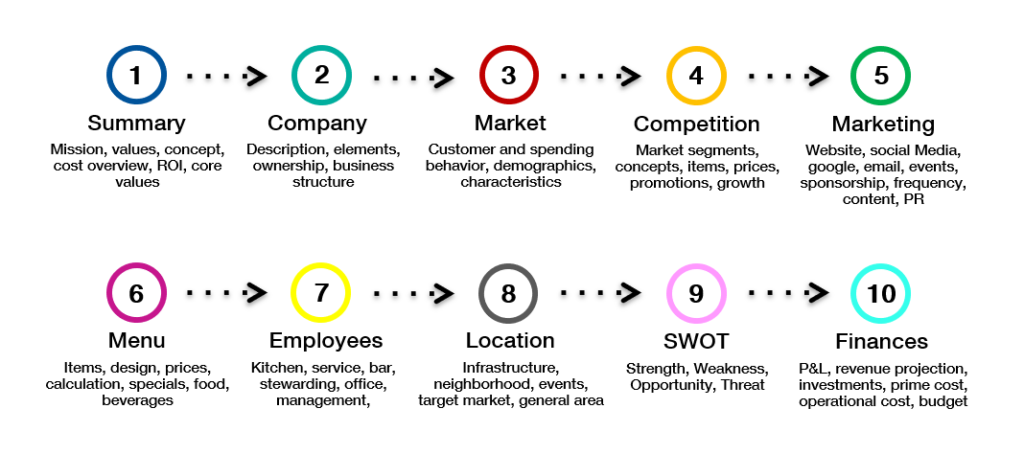
Executive Summary
Vision, Mission, Values, Concept, Costs, ROI
Your business idea, your intention, turnover and profit prospects, finance requirements, risks, what you’ve done so far, and today’s situation.
In any business strategy, the executive summary comes first. It introduces and sums up your whole concept. This section should introduce the major parts covered throughout the business strategy. It should grab the reader’s interest and persuade them to continue reading.
Company Overview
Description, Elements, Ownership, Business Structure
Description of the operation, your products and services, why the market needs exactly your business, business life cycle, legal protection, technology, guests, capacities, suppliers, production facilities.
Begin explaining the high-level features of the prospective business in this part. The firm overview describes the ownership structure, location, and business idea. Create a vision for the guests’ experience. Describe the company. Determine your restaurant’s service style, appearance, layout, theme, and all other distinguishing features.
Market
Market Area, Spending Behaviour, Demographics
Market analysis, capacity, potential, strategy, targeted customer groups, trends, entrance barriers, growth of market
The restaurant sector is highly competitive, so establishing your speciality is critical. What will set your operation apart? You should have a good concept of who your restaurant will appeal to and who you hope will return. Describe your target market and how it compares in terms of diner demographics, traits, and behaviours to the restaurant industry as a whole.
Competitors
Concepts, Items, Prices, Promotions, Growth
Competitors, their position in the market, their strengths and weaknesses, products, characteristics, competitive advantages, strategy of the competitor(s), co-operations, appearance in the market
One of the most difficult hurdles facing the restaurant sector is fierce competition. Competition, on the other hand, can benefit your restaurant business by bringing in new customers.
Marketing Plan
Website, Social Media, Google, Email, Events, Sponsorship, Frequency, Content, PR
Your segment in the market, selling arguments (quality, design, price), your target markets (geographic, demographic, etc.), customer groups
The food and beverage industry is becoming increasingly competitive. As a result, marketing is an important part of drafting a restaurant business plan. Before you begin, you should have a clear idea of your market approach. Make a marketing budget for both online and offline campaigns. A percentage of every coin you earn should go into marketing.
Menu
Items, Design, Prices, Calculation, Specials, Food, Beverages
Menu sample, design, CI, items, content, structure, wording, calculations, engineering – matrix of products (question marks, stars, etc.)
Because the menu is the most visible representation of a restaurant’s brand, it should be more than just a list of things. Include your logo and create a mock-up menu design. It goes without saying that it is the heart of your restaurant strategy. Business owners typically agree that if you provide outstanding cuisine, your restaurant can withstand the competition. As a result, the restaurant business plan must include what you want to offer.
Team, Staff, HR
Kitchen, Service, Bar, Stewarding, Office, Administration, Consultants And Management
HR, recruitment, OrgChart, job profiles, job descriptions, SOPs, policies, training, workflow, CVs, references
You will need an overview of how many workers you will employ and what jobs they will have to run your restaurant, from waiters and chefs to management to partners. Pay special attention to your management team’s makeup and structure. These are the people who will determine whether you succeed or fail. Partners and investors will want to see that you have carefully considered how your restaurant will operate and who will execute your strategy.
Location, Production
Area, infrastructure, neighbourhood
Technology, capacities, suppliers, production facilities, logistics, size, cost, advantages and disadvantages of locations, the investment needed to maintain and to increase the capacity
Most prospective restaurant owners do not have a precise site in mind when they write and present their business plans, so concentrate on the broad region or city where you want to locate the restaurant and why you choose it. Include items like the local economy’s growth, big citywide events, and neighbouring infrastructural projects. Compare the current market conditions to the market you want to reach.
SWOT
Strengths, Weaknesses, Opportunities, and Threats
A SWOT Analysis should be included in your restaurant business plan because it helps you identify internal and external factors that will affect the restaurant’s future. It not only warns you about what may go wrong and your vulnerabilities, but also breaks down your strengths and opportunities so you can use them better.
Financial Analysis
P&L, Revenue Projection, Investments, Prime Cost, Operational Cost, Budget
Financial analysis is usually one of the last sections of a business strategy. Investors demand a summary of how you plan to spend their money in the first year, as well as a comparison of estimated expenditures and income. Be sure to include a few key items in this area.
What could/should (but not limited to) be included in the business plan:
- Investment Strategy
- Profit and Loss (P&L) Statement Proposed
- Analysis of Break-Even
- Cash Flow Forecast
- Where the money comes from (capital)
- Where Does Your Money Go? (expenses)
- Capital investments and costs
- Expenses of Operations
- Cost Projection
- Projection of Revenue
- Per capita income
- Budgets
Discover

PX-eBook.com, FnB Specialist Literatur

